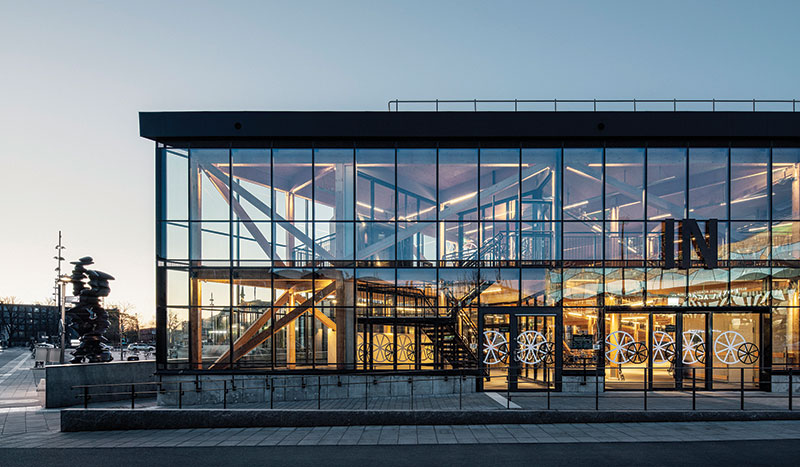
Reading List: One of the earliest municipal parking lots in the United States was built in 1922 in Los Angeles. Over the last 100 years, the global parking industry has grown to an estimated valuation of nearly $100 billion worldwide. Many older parking structures will eventually be converted to other uses, and newer facilities are often equipped with solar panels, electric-vehicle charging stations, stormwater management, or multimodal options such as bike racks or public transportation.

Technology is also allowing more cars to be stored in smaller spaces where that is cost effective. While some cities are likely overbuilt for public and private parking, the intelligent use and management of parking facilities is essential to economic growth in the 21st century.

In partnership with:

Metropolis Logo


Ten inventive approaches to stashing vehicles enliven the urban environment.
A redevelopment of a 1980s strip center in a suburban town programs urban-style mixed uses with 1,500 fewer parking spaces than would have been required without sharing.

ULI has launched a first-of-its-kind central resource cataloging innovative parking policy reforms intended to promote more efficient use of land and creation of healthier neighborhoods. Though cities across the United States and beyond have long required new developments to provide a set number of off-street parking spots, research shows that these requirements can lead to an oversupply of parking.


This article is adapted from Shared Parking, Third Edition, published in spring 2020 by ULI, ICSC, and the National Parking Association.
Incentivized by city parking policies, private developers provide fewer parking spaces or increase density in new projects.
Two architects address ten common concerns about shrinking parking requirements.
A new study of TOD and parking, <em>Empty Spaces</em>, which focused on five case studies and was released by Smart Growth America in partnership with the University of Utah’s College of Architecture and Planning, found that even some of the top TOD projects in the United States had built too much parking.
A design challenge inspires a proposal for flexible parking structures that can house a range of uses—and spur mixed-use, transit-oriented development.
EN RELATION
Signaler

ULI France Livre blanc: Décarbonation de l'immobilier: leviers, solutions et valorisation

Le Product Council ULI France "Décarbonation" a pour objectif d’offrir aux entreprises un accès privilégié à des solutions opérationnelles et à des dispositifs de formation dédiés à la décarbonation.
Séminaire en ligne

ULI Europe Webinar: Asset Sustainability Committees Best Practice Guide Launch

Watch the launch of ULI Europe's new Asset Sustainability Committees Best Practice Guide, developed through the C Change programme to help owners and property managers of multi-let commercial buildings work effectively with occupiers to help accelera...
Signaler

ULI Alberta – 2026 Emerging Trends in Calgary & Edmonton

ULI Alberta brought industry leaders together in Calgary and Edmonton on February 3–4 to explore the forces shaping real estate in 2026. Featuring insights from Wendy Waters, PwC Canada’s Spyros Stathonikos, and Patrick Tod, Emerging Trends 2026 spar...
Sujets
Conception et planification
Secteur public